
LED vs Laser Therapy for Dogs: What Every Dog Owner Needs to Know
Professional Standards, Clinical Precision, and Informed Choice
When your dog is dealing with a health or mobility issue, whether that is ongoing stiffness, recovery from injury, support for skin and wound healing, or inflammation, you seek professional support because you want a clear, reliable result.
As a holistic vet nurse specialising in advanced medical laser therapy (trained under Lars Hode, one of the leading researchers in medical laser therapy), I am seeing increasing confusion around what is being offered under the terms “red light”, “LED”, and “laser therapy”. Many owners are being treated with entry-level devices designed for home support rather than clinical treatment.
To make the right decision for your dog, it is important to understand how different types of light behave in the body, and what they are actually capable of reaching.
A Note on Clinical Integrity:
In recent years, the market has been flooded with affordable LED “wraps” and consumer-grade handheld lights. While these have a place for basic home comfort, they are frequently being rebranded as “Clinical Laser Therapy” by practitioners who lack formal medical training. For a dog owner, this is misleading. There is a vast clinical difference between simply "shining a light" on a dog and delivering a calculated, therapeutic dose of medical laser energy to a deep-tissue injury. Using a home-use device as a substitute for clinical treatment often leads to underwhelming results and, more importantly, delays the proper recovery of your dog.
⸻
Understanding the Difference: Red Light, LED and Medical Laser
Both LED devices and medical lasers use red or near-infrared light, which is why everything is often grouped together as “red light therapy” or “laser therapy”. This is where the confusion, and often misleading marketing, begins.
“Red light” is not a device. It simply describes part of the light spectrum. We have a full spectrum of light, and each specific wavelength has its own properties and effects in the body.
That light can be delivered in very different ways, and how it is delivered determines what it can actually do in the tissue. This is grounded in biology and physics, with decades of research behind it.
LED (Light Emitting Diode)
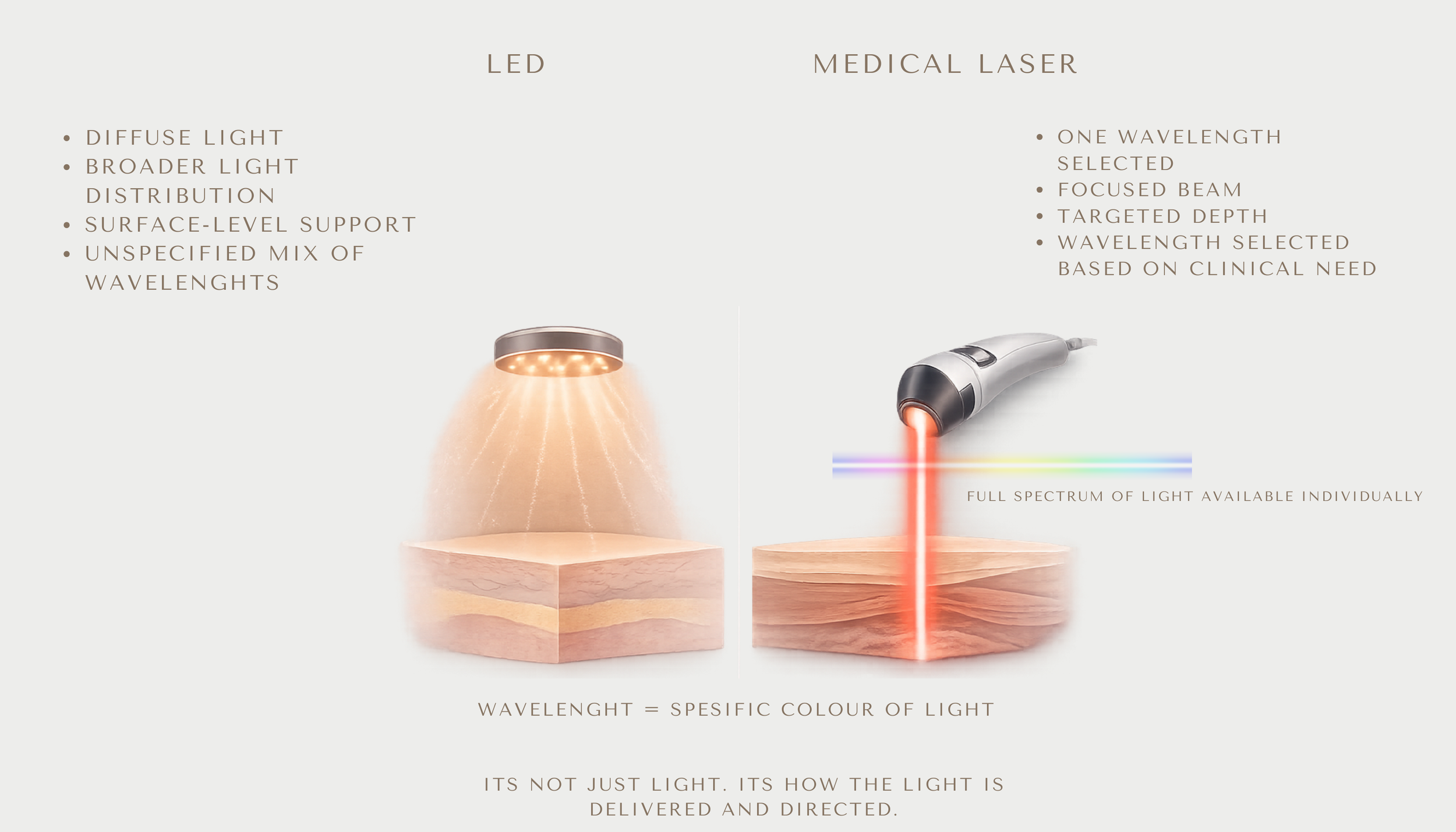
LED devices emit light that is more diffuse and less controlled. The light spreads out quickly, which makes it gentle and suitable for surface support such as skin, circulation, and general comfort. Some devices may include one or multiple wavelengths, but this is not always clearly defined by the manufacturer, which can make it difficult to know exactly what is being delivered to the tissue.
Laser (Light Amplification by Stimulated Emission of Radiation)
A medical laser delivers a focused beam of light at a single, specific wavelength. Each wavelength is selected based on what we are treating, as different wavelengths reach different depths and interact with tissues in different ways.
The power output of the device is also important and is what distinguishes a home-use device from a professional system. This level of precision allows for a more targeted and consistent approach, supported by a stronger body of research for specific wavelengths and clinical outcomes.
⸻
Where Each Approach Fits
Both LED and laser therapy sit within the same category of light-based treatment, but they are typically used in different ways.
LED tends to be used for more superficial support. Because the light spreads over a larger area, and wavelength is mixed and not spesific, it can often be helpful for skin, circulation, and general tissue support, particularly in a home setting where ease and safety are important.
Laser therapy allows for a more targeted approach. By selecting a specific wavelength and delivering it in a focused beam, we can reach different depths and work more precisely with muscles, joints, inflammation, and deeper structures, as well as skin when needed.
Both approaches can support the body, but they serve different roles. One is gentle and more general, the other is more precise and clinically directed.
Why Expertise Matters More Than the Device
A medical-grade laser is a precision tool, but it is only as effective as the person operating it. A qualified practitioner doesn't just "turn on a light"; they calculate specific Joules, frequencies, and depths based on your dog’s unique anatomy and stage of healing.
When a practitioner uses a "one-size-fits-all" LED device with no formal educational background in photobiomodulation, they are often unable to explain the dosing or the biology behind the treatment. As a client, you deserve to know that the therapy being paid for is grounded in clinical reasoning, not just a marketing label.
⸻
Home Support and Clinical Treatment
Both LED and laser have a place when used appropriately. The important distinction is not just the type of light, but the level of the device and how it is being used.
Home-use devices
Home-use devices can include both LED and lower-powered laser units. These are designed for safe, regular use by owners and are typically used to support comfort, circulation, and day-to-day maintenance. I often guide clients in using home-use laser devices between sessions to help maintain progress, or if they don’t have any medical laser professionals in their area, I guide them over online consultations with an appropriate home-'use device.
Professional medical devices
In a clinical setting, both LED and laser technologies can be used at a higher and more controlled level. These devices require training, experience, and precise dosing.
Laser therapy, in particular, has a substantial body of research supporting specific wavelengths and treatment protocols. Treatment is not simply applying light. It is a considered process where the wavelength, dose, and frequency are selected based on your dog’s condition, structure, and response.
A professional session is not defined by the name of the device, but by the level of precision, control, and clinical reasoning behind its use.
The Critical Distinction: Supportive vs. Curative Care
It is easy to assume that a "Red Light" device is a "Red Light" device regardless of who is holding it. However, the difference between a home-use LED and a professional use Class 3B laser treatment is the difference between maintenance and medicine.
There is a growing and concerning trend of practitioners using "Supportive" home-grade LED devices while charging "Clinical" professional fees. As a dog owner, this should concern you for two primary reasons:
1. Value for Money
If a practitioner is using a device that you could simply purchase yourself for home use, you are paying a professional premium for a consumer-grade tool. When you invest in a professional service, you should expect the use of professional-grade, medical technology that isn't available to the general public.
2. The "Shot in the Dark"
Without the educational background to calculate specific dosing (Joules) or understand the biological depth required for a specific injury, the treatment becomes a guess. This lack of clinical reasoning is misleading to the client and unfair to the patient.
Supportive vs. Curative: Choosing the Right Level of Care
It is easy to assume that all "Red Light", “Lasers” or “Light Therapy” is the same. However, the difference between a home-use LED and a clinical Class 3B laser treatment is the difference between maintenance and medicine.
• Home-Use (Supportive): These devices are designed for broad, safe application. They provide gentle surface stimulation to support circulation and general comfort. They are a fantastic tool for owners to use between professional sessions to maintain progress.
• Clinical (Curative/Targeted): Clinical therapy involves high-precision, Super-Pulsed 904nm technology that can penetrate deep into joint capsules and spinal structures without losing energy to the skin or hair coat.
Why the Practitioner is the Most Important Variable
A professional session is defined by more than just a device; it is defined by a deep understanding of Canine Anatomy, Pathology, and Tissue Biology.
• Precision Positioning: Light therapy is highly dependent on the angle of incidence and the exact anatomical placement. A professional knows precisely where the joint capsule lies, the depth of the target muscle, and how to position the probe to bypass dense fur or superficial tissue.
• Pathological Understanding: We don't just treat "a leg." We treat a specific stage of inflammation, a specific type of nerve impingement, or a specific grade of tendon injury. Each requires a different calculation of Joules and frequency.
• Dynamic Monitoring: Throughout the session, a trained clinician monitors the tissue response. We adjust the technique in real-time based on the dog's structure and clinical reaction—something a static "strap-on" LED wrap can never achieve.
The Result of the Wrong Choice:
• For the Dog: Using a home-use device for a deep-seated clinical issue often results in a slower recovery because the light simply cannot reach the target tissue with enough energy to trigger a healing response.
• For the Owner: You end up paying professional clinical fees for a result you could have achieved (or surpassed) with the right guidance and a home unit of your own.
Clinical laser therapy is not just "applying light", it is the medical application of specific energy to a specific depth. If a practitioner cannot explain the difference between their device and a home-use LED, or cannot justify their dosing protocol, they are operating in that "Middle Ground" that lacks clinical integrity.
⸻
Why Wavelength Matters
Not all light behaves the same in the body. Different wavelengths reach different depths and interact with tissues in different ways, which is why selection matters.
In my work, I use a combination of wavelengths depending on what we are treating:
• 660 nm (red light) for surface tissues, skin, and wound healing
• 808 to 810 nm (near-infrared) for muscles and joints
• 904 nm (super-pulsed) for deeper structures, and also highly effective for inflammation, arthritis, joints, and muscles when used correctly
These wavelengths are not chosen at random. They are supported by research and used with intention to reach specific tissues and achieve a therapeutic effect.
⸻
Class 3B and Class 4 Laser Systems
Laser devices are often categorised as Class 3B or Class 4, which refers to their power output and safety classification, not necessarily their effectiveness.
Class 3B lasers, particularly super-pulsed systems such as 904 nm, have been widely studied over several decades and are supported by a substantial body of independent, peer-reviewed research.
Class 4 lasers are higher-powered continuous wave systems that have become more common in recent years, particularly within veterinary settings. While they can deliver higher energy outputs, the research base is still evolving and varies depending on the device and protocol used.
Importantly, research does not show that higher power alone leads to better results. Outcomes depend on delivering the right dose to the right tissue, based on the correct diagnosis.
In practice, outcomes are not determined by class alone, but by how the device is used. Wavelength selection, dosing, and clinical reasoning remain the most important factors.
⸻
What to Ask Your Practitioner
If you are considering laser therapy, it is reasonable to ask:
1. Is this an LED device or a medical laser?
Both can be useful, but they serve different purposes.
2. Which wavelengths are being used for my dog’s condition?
Treatment should be adapted, not generic.
3. How is the dose being determined?
A professional should be able to explain how they are selecting and adjusting treatment.
4. What training has been completed to provide medical laser therapy?
While industry standards vary, a practitioner should have formal training and a clear understanding of treatment protocols. WALT approved is Gold Standard.
Red Flags: How to Spot "Inadequate" Therapy
If you are seeking professional treatment for your dog, be wary of the following:
• The "Broad-Spectrum" Claim: If a practitioner says their device "does everything" with a single LED wrap or a generic red light, they are likely using a surface-level home tool. Professional therapy requires specific, switched wavelengths (like 904nm for deep tissue) tailored to the specific injury.
• The Lack of "Super-Pulsing": For deep-seated issues like arthritis or spinal inflammation, a continuous light (typical of cheap LEDs) and red light cannot reach the target depth without losing energy or being absorbed by pigments (skin, hair, blood etc). A professional should be able to explain why they are using a device to reach the deeper structures.
• No Clinical Calculations: A practitioner should be able to tell you exactly how many Joules of energy are being delivered per site. If they are just "moving a light around" for a set amount of time without calculating the dose based on your dog's size and condition, it isn't a medical treatment, it's a guess.
• Marketing Over Methodology: Be cautious of practitioners who focus more on the "brand" of a home-use device rather than their own clinical training. Ask if their protocols are informed by the World Association for Laser Therapy (WALT) or recognized researchers like Lars Hode, Jan Turner etc
• Static "Set and Forget" Treatments: Clinical laser therapy is dynamic. If a practitioner simply straps a device to your dog and walks away, they aren't monitoring the tissue response or adjusting the technique. True medical laser therapy is a hands-on, considered process.
⸻
Expectations and Results
In my approach, the focus is always on using the right device in the correct clinical way.
Medical laser therapy allows for a level of precision, depth, and consistency that is difficult to achieve with more diffuse light sources. This becomes particularly important when working with deeper structures, inflammation, joint conditions, or more complex cases, while also remaining highly effective for skin and wound healing.
Home-use devices can then play a valuable role in maintaining progress between sessions and supporting ongoing comfort, or where clinical options is not available near by.
Understanding the difference allows you to make informed choices and ensures your dog receives care that matches both their needs and your expectations.
⸻
Research and Standards
My protocols are guided by established research in photobiomodulation, including the work of the World Association for Laser Therapy (WALT) and leading researchers in the field.
This allows me to apply treatment in a way that is both clinically considered and evidence-informed.
References:
